How to Read Peptide Sequence Notation: One-Letter Codes and Termini
Transcribe one-letter residue codes, identify N-terminal acetylation and C-terminal amidation, and record which structural details are specified.
Read an ordinary linear peptide from the N-terminus to the C-terminus. Translate one-letter or three-letter residue codes, then check any notation for terminal groups, stereochemistry, modifications and cross-links. A bare letter string can leave those structural details unspecified.
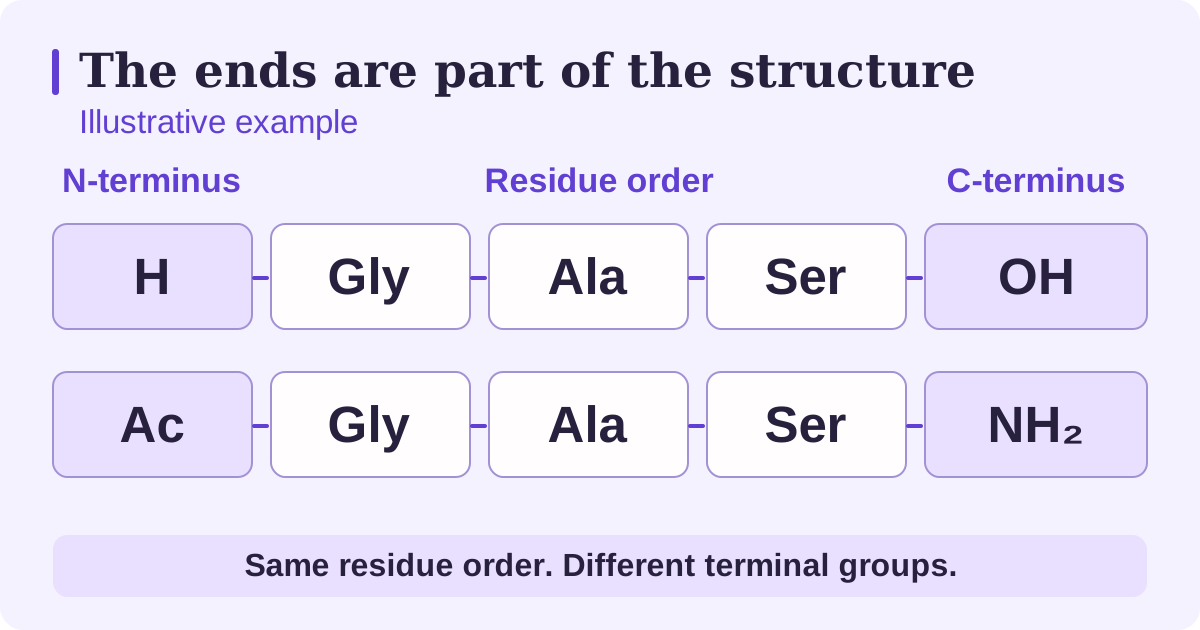
Translate the residue codes in order
Gly–Ala–Ser and GAS both represent the residue order glycine, alanine, serine. In an ordinary linear peptide, the N-terminal end appears on the left and the C-terminal end appears on the right. The first position in this short chain is Gly. If the text identifies a fragment of a longer precursor, establish whether its positions refer to the fragment or to the precursor.
Use the convention stated by the source when symbols are ambiguous. IUPAC and IUBMB use B where aspartic acid or asparagine has yet to be distinguished, and X for an unknown or atypical residue. An ambiguous symbol preserves information about the source’s uncertainty. Record it as written until a legend, cited sequence or methods section resolves it.
IUPAC and IUBMB, One-letter sequence symbols, 3AA-20 and 3AA-21
Read the groups attached at both ends
Compare these fictional descriptions. H–Gly–Ala–Ser–OH denotes the tripeptide with free amino and carboxyl termini. Ac–Gly–Ala–Ser–NH₂ denotes an N-acetylated and C-amidated version. In this notation Ac names the acetyl group and –NH₂ on the right denotes a carboxamide. Both versions contain Gly, Ala and Ser in the same order. They represent different covalent structures.
When a source prints only GAS, use its stated convention and context before filling terminal fields. A database sequence for a precursor and a methods table describing a synthesized peptide can use the same residue shorthand. For a synthesized construct, the methods or material record may supply the terminal groups separately.
IUPAC and IUBMB, Peptide symbolism, 3AA-18 and 3AA-19 · IUPAC and IUBMB, One-letter sequence symbols, 3AA-20 and 3AA-21
Look for stereochemistry, linkage and positions
A notation such as Gly–D-Ala–Ser specifies D-alanine in the second position. In a one-letter string, D is the residue code for aspartic acid. Check a source’s legend before interpreting lowercase letters, brackets or superscripts. For a side-chain modification, capture the position and group together. In a disulfide-linked example, Cys at positions 2 and 8 describes two residues. The separate annotation Cys2–Cys8 identifies the bonded pair. If several cysteines appear and the source gives no bond map, record the connectivity as unspecified.
PubChem’s reduced glutathione entry provides a real example of why linkage matters. Its condensed description uses γ-linked Glu. The glutamate side-chain carboxyl forms the linkage to Cys. A short string that only lists the residues can omit that detail. For cyclic or multichain peptides, use the full connectivity notation or a structure diagram that identifies the bonds.
IUPAC and IUBMB, Peptide symbolism, 3AA-18 and 3AA-19 · IUPAC and IUBMB, One-letter sequence symbols, 3AA-20 and 3AA-21 · PubChem, Reduced glutathione, CID 124886
Preserve the original before expanding it
A review record can include the original text, its source and version, the interpreted residue order, both terminal groups, modifications with positions, stereochemistry and connectivity. For a fictional label Ac–Gly–D-Ala–Ser–NH₂, that record would name an N-terminal acetyl group, D-Ala at position 2 and a C-terminal amide. The residue-only shorthand GAS can help readers locate the backbone, while the complete description remains the source for structural comparisons.
Transcribe a label and check a residue-only string
| Record field | Ac–Gly–Ala–Ser–NH₂ | GAS alone |
|---|---|---|
| Residue order, N to C | Gly → Ala → Ser (GAS) | Gly → Ala → Ser (GAS) |
| N-terminal group | Acetyl | Unspecified in this record |
| C-terminal group | Carboxamide | Unspecified in this record |
| Explicit stereochemistry | No separate stereochemical annotation in this label. Gly is achiral. | No separate stereochemical annotation in this string. Check the source convention for Ala and Ser. |
| Additional linkage or material form | Unspecified | Unspecified |
In ProForma 2.1, [U:Acetyl]-GAS-[U:Amidated] encodes these terminal groups using Unimod terms. The HUPO-PSI validator recognizes the left annotation at the N-terminus and the right annotation at the C-terminus.
Count the residues in GAS or try the same sequence with whitespace. Use the full transcription for structural comparisons.
HUPO Proteomics Standards Initiative, ProForma 2.1 specification and validator · Unimod, Acetyl (record 1) · Unimod, Amidated (record 2)