How to Check Peptide Names, CAS Numbers and PubChem IDs
Resolve names to chemical structures or sequence features using two examples from public databases.
Use PubChem CIDs to compare standardized chemical structures, PubChem SIDs to inspect the depositor’s record, and UniProt accessions and feature coordinates to locate a sequence or processed peptide. Verify the exact structure or feature behind any matching name.
Start with what the name refers to
Copy the spelling, source, material form and any sequence or structure supplied with a name. A label may identify a precursor, a processed chain, a modified analog, a salt, or a construct used only by the authors. Search by the name to find candidates, then compare the features that determine identity for your use, such as residue order, termini, linkage, stereochemistry and oxidation state. A synonym list can help you find records. Compare the displayed structure before deciding which record describes the intended entity.
PubChem uses a Substance ID (SID) for a contributor’s submitted record. When a submitted structure can be standardized, PubChem can link it to a Compound ID (CID) representing the resulting chemical structure. Multiple contributors can link to the same CID. Keep the SID and depositor name if your question concerns who submitted a synonym or annotated a material. Record the CID and verify the structure if your question concerns chemical identity.
PubChem, Data organization for Substance and Compound records
Compare reduced and oxidized glutathione
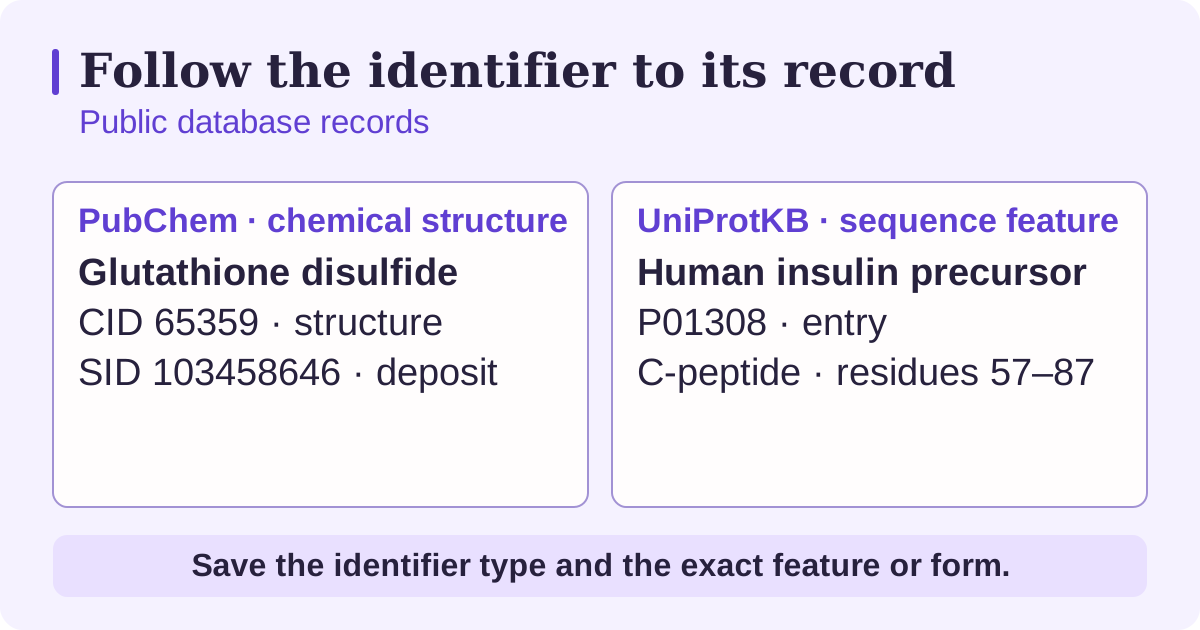
PubChem identifies reduced glutathione (GSH) as CID 124886 and glutathione disulfide (GSSG) as CID 65359. In reduced glutathione, the structure contains a single tripeptide with a cysteine thiol and a γ-glutamyl linkage. The disulfide record shows two glutathione units joined through their cysteine sulfur atoms. A search for “glutathione” may surface both records. Use the structure and oxidation state to decide which ID to record, and check any additional salt or hydrate designation in the material description.
For a record-level example, PubChem SID 103458646 links to CID 65359. The SID lets you inspect that particular deposit, while the CID gives you the standardized structure and linked records.
PubChem, Reduced glutathione, CID 124886 · PubChem, Glutathione disulfide, CID 65359 · PubChem, Substance record SID 103458646
Match a precursor accession to a specific feature
UniProtKB P01308 is the human insulin precursor entry. Its reference sequence contains 110 residues. The B-chain feature is at positions 25–54, and the A-chain feature is at 90–110. The C-peptide is annotated as a propeptide at positions 57–87. An accession alone names the entry containing these features. To identify one of them, record the accession, the feature label and residue coordinates, and the feature identifier if present. An example is “UniProtKB P01308, C peptide, precursor positions 57–87, feature PRO_0000015820.”
If a paper says “fragment 12–25,” locate the exact accession, isoform or sequence version it uses and check whether the numbering is for the precursor or a processed peptide. Copy any reported terminal groups or other changes from the paper itself. A synthetic fragment’s material description can contain details beyond those in the reference sequence annotation.
UniProtKB, Human insulin precursor and annotated features, P01308
Leave an auditable cross-reference
Keep the original alias, the source document, the identifier type and value, and the evidence linking the alias to the specific structure or feature. State any unresolved chemical or numbering details. This lets a colleague revisit the exact record if an annotation changes or if a second source uses the same alias for a different construct.
Verify a reference record for oxytocin
Oxytocin reference records checked . The supplier labels below are fictional. Check whether the proposed reference fits the actual material description before recording an equivalence.
| Supplier alias or catalog label | Database or registry reference | Entity and evidence | Review status |
|---|---|---|---|
| “OXT reference,” catalog EDU-OXT-01 | CAS RN 50-56-6 · CAS Common Chemistry | The registry record identifies oxytocin. Its InChIKey matches the PubChem structure record below. | Registry entry checked directly. Obtain the supplier’s form and lot documentation for EDU-OXT-01. |
| “OXT reference,” catalog EDU-OXT-01 | PubChem SID 4008 · KEGG deposit C00746 | KEGG’s submitted substance record is mapped to CID 439302 by PubChem. | Deposit and mapping checked. The SID identifies the deposit. |
| “OXT reference,” catalog EDU-OXT-01 | PubChem CID 439302 · View the 2D structure | Standardized oxytocin structure with InChIKey XNOPRXBHLZRZKH-DSZYJQQASA-N. The reference represents the peptide without a counterion in the displayed structure. | Structure checked. Compare the actual material’s covalent structure, salt or counterion, and hydration separately. |
| “OXT reference,” catalog EDU-OXT-01 | UniProtKB P01178 · feature PRO_0000020495, precursor positions 20–28 | Human precursor entry and the annotated oxytocin peptide within it. The sequence is CYIQNCPLG, with a 20–25 disulfide bond and glycine amidation at position 28 in precursor coordinates. | Sequence feature checked. The accession and residue coordinates serve as a sequence reference. |
| “OXT-Ac,” catalog EDU-OXT-02 | Candidate CAS RN 50-56-6 from a hypothetical alias search | The label’s “Ac” and the supplied form are unexplained. The search result supplies a candidate for comparison. | Open. Ask what “Ac” means and request a structure and a primary record confirming the identifier for that form. |
The checked reference records agree on the mature oxytocin structure. A supplier’s form or lot remains a separate claim that needs evidence from its own documentation.
CAS Common Chemistry, Oxytocin, CAS RN 50-56-6 · NCBI PubChem, Oxytocin, CID 439302 · NCBI PubChem, KEGG oxytocin deposit SID 4008 · KEGG Compound, Oxytocin, C00746 · UniProtKB P01178, human oxytocin precursor
Sources & further reading
- PubChem, Data organization for Substance and Compound records
- PubChem, Reduced glutathione, CID 124886
- PubChem, Glutathione disulfide, CID 65359
- PubChem, Substance record SID 103458646
- UniProtKB, Human insulin precursor and annotated features, P01308
- CAS Common Chemistry, Oxytocin, CAS RN 50-56-6
- NCBI PubChem, Oxytocin, CID 439302
- NCBI PubChem, KEGG oxytocin deposit SID 4008
- KEGG Compound, Oxytocin, C00746
- UniProtKB P01178, human oxytocin precursor