Peptide Free Form, Acetate or TFA: Compare Material Descriptions
Compare covalent structures and salt or physical forms, and check what a material amount describes.
Compare the peptide’s sequence, termini, stereochemistry and covalent modifications first. Then check the counterion, water or solvent content, and physical presentation. A salt designation or lyophilized label adds information about the supplied material that a residue sequence alone cannot express.
Describe the covalent structure
List the residue order, terminal groups, stereochemistry and any linked or modified positions. For example, H–Gly–Ala–Ser–OH and Ac–Gly–Ala–Ser–OH have the same residue order. The latter has an N-terminal acetyl group joined by a covalent bond. In another pair, a free C-terminal carboxyl group and a C-terminal amide are different end groups on the peptide itself. Preserve those changes in the primary structure description.
For structures with multiple possible disulfide pairings, record the bonded residues when the source provides them. Equal residue order and equal mass can leave pairing unresolved. Copy the source’s structure diagram or connectivity notation where a shorthand sequence omits these bonds.
IUPAC and IUBMB, Peptide symbolism, 3AA-18 and 3AA-19 · EMA, Synthetic peptides guideline, §§ 2, 4.1, 4.3 and 4.4
Interpret counterions and physical presentation
A counterion accompanies a charged peptide in a salt. An acetate designation can describe the supplied peptide salt. An Ac– prefix, in the appropriate notation, describes a covalently attached acetyl group. Ask which meaning the document intends if it uses an abbreviated label. When the amount of counterion matters to a comparison, look for measured content or a justified composition, including its unit and basis. The salt name by itself may leave the amount unspecified.
Lyophilized describes freeze-dried presentation. A lyophilized material may still contain water. A solution description may list concentration, solvent or buffer components, while a powder description may report moisture and other constituents separately. Compare the reported measurement to the form being described, particularly when the documents list an anhydrous figure and an as-received figure for the same lot.
IUPAC and IUBMB, Peptide symbolism, 3AA-18 and 3AA-19 · EMA, Synthetic peptides guideline, §§ 2, 4.1, 4.3 and 4.4 · McCarthy et al. (2023), Reference Standards to Support Quality of Synthetic Peptide Therapeutics
Compare two descriptions line by line
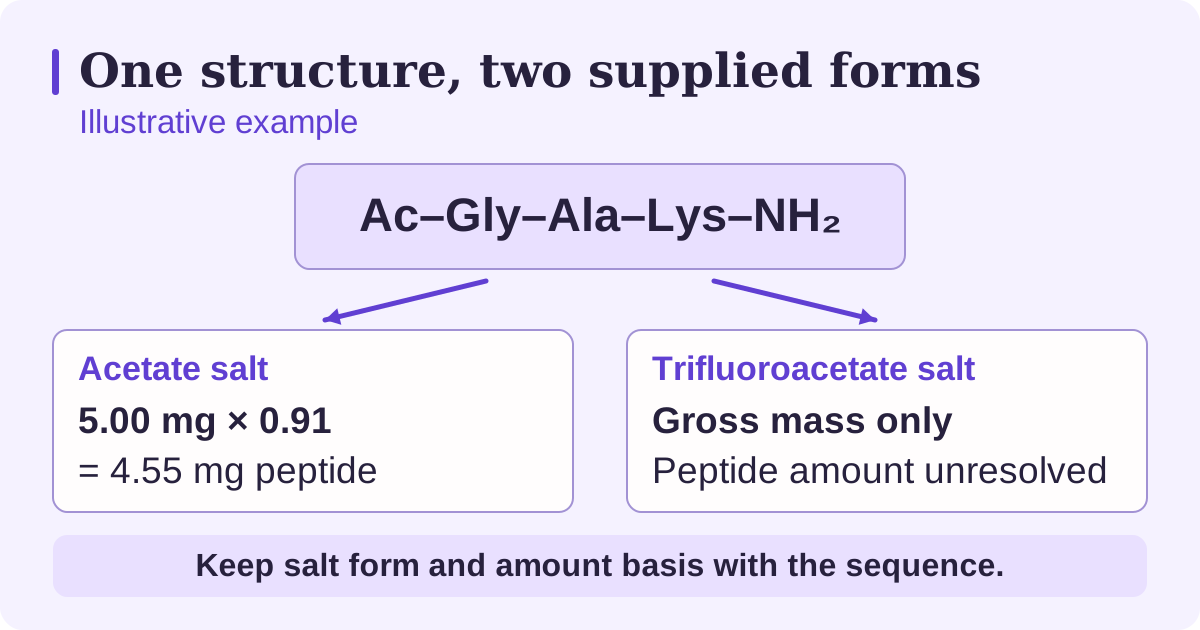
Suppose two fictional records both show Ac–Gly–Ala–Lys–NH₂. Record A identifies an acetate salt and reports 0.91 mg peptide moiety per mg of as-received material. Record B identifies a trifluoroacetate salt and states only a gross powder mass. The supplied forms differ, and only Record A states a quantitative peptide mass fraction. If 5.00 mg of the material in Record A is measured on that same basis, the stated fraction corresponds to 4.55 mg of peptide moiety (5.00 × 0.91). For Record B, the amount of peptide moiety remains unresolved without an applicable value or a justified composition. Water and other material contributions belong in that assessment when relevant.
EMA’s synthetic peptide guideline, written for medicinal product applications, describes structural characterization, counterions and water as distinct attributes. The reference-standard work of McCarthy and colleagues provides examples of measuring these contributions in bulk peptide materials.
EMA, Synthetic peptides guideline, §§ 2, 4.1, 4.3 and 4.4 · McCarthy et al. (2023), Reference Standards to Support Quality of Synthetic Peptide Therapeutics
Record the information needed to repeat the comparison
For each record, capture the exact structure, counterion or salt if specified, physical presentation, relevant measured constituents and the basis of the quoted amount. Mark unreported fields explicitly. If a catalog says “5 mg,” clarify whether it describes gross material, peptide moiety or another assigned quantity. If a document offers a calculated value, retain the inputs and whether the calculation uses as-received or corrected material.
Compare these fictional records for GAK. Each row records what the source actually supplies. Copy the table into a material comparison and retain the original source wording.
| Material field | Record A | Record B |
|---|---|---|
| Original structure description | Ac–Gly–Ala–Lys–NH₂ | GAK only |
| Residue order, N to C | Gly → Ala → Lys | Gly → Ala → Lys |
| N-terminus and C-terminus | N-acetyl and C-terminal amide | Unreported |
| Declared counterion or form | Acetate salt | Unreported |
| Measured counterion content | 4.0% acetate by mass as received, by ion chromatography | Unreported |
| Physical form and water content | Lyophilized powder, 3.0% water by mass as received, by Karl Fischer titration | Lyophilized powder, water content unreported |
| Mass and reporting basis | 5.00 mg gross powder, 0.91 mg peptide moiety per mg of as-received material | 5.00 mg gross powder, peptide-moiety mass unreported |
Comparison status: open. The residue order agrees. Ask the source of Record B to specify both termini, the supplied form, the water and counterion content where relevant, and the amount of peptide on a stated basis. The label “free form,” when explicitly supplied, belongs in the form field along with any data on residual counterions.